bluename
 How to Distinguish Common Cosmos Varieties? A Hands-On Guide from a Fellow Gardener
Have you ever found yourself staring at a sea of cheerful, daisy-like flowers, utterly captivated but completely clueless about which cosmos variety you’re actually admiring? You’re not alone. For years, I simply enjoyed their vibrant colors, lumping them all together as “those pretty, feathery flowers.” It wasn’t until I tried to plan my garden intentionally, aiming for specific heights, bloom times, and color schemes, that I hit a wall. I’d order seeds labeled “cosmos,” only to get plants that looked nothing like my neighbor’s, or I’d struggle to identify the self-seeding volunteers popping up in my beds. The frustration was real. That’s when I embarked on a personal mission to learn how to tell common cosmos varieties apart, not from a textbook, but from the dirt under my fingernails. Over a dedicated two-week observation period in my own garden, I developed a practical, foolproof system. I’ll share my steps, the mistakes I made, and the clear distinctions I discovered, so you can confidently identify these garden favorites.
My journey began with the realization that most common cosmos fall into two primary species: Cosmos bipinnatus and Cosmos sulphureus. While hybrids abound, understanding these parents is the key.

Getting Started: The Two-Week Observation Framework
I didn’t just glance at my plants. I committed to a daily 10-minute inspection for two weeks, focusing on specific traits at different growth stages. I kept a simple notebook, sketching and jotting down notes. This wasn’t a passive look; it was active investigation. The first pitfall I encountered was trying to identify them from a single photo or at just one point in time. Cosmos can look different as seedlings, in early growth, and in full bloom. My advice? Start your observation when the plants have at least 3-4 sets of true leaves, and continue through to the first few blooms opening.
Trait One: The Foliage Tells the First Story
This was my “aha!” moment. The leaves provide the earliest and most reliable clue.
Cosmos bipinnatus: I ran my fingers along the foliage. The leaves of this variety are finely dissected, almost thread-like, giving them a delicate, feathery, fern-like appearance. They look soft and airy. The Royal Horticultural Society (RHS) describes this as “pinnately divided” foliage, which is a perfect technical term for that lacy look. The overall plant structure often seems more willowy and graceful from the start.
Cosmos sulphureus: The contrast was striking. The leaves are broader, with deeper, more pronounced serrations or lobes. They feel sturdier to the touch and have a rougher texture. They are still divided, but the segments are wider, giving a coarser, more robust impression. Think of the difference between fine dill fronds and broader, flatter parsley leaves—it’s a similar visual gap.
My Mistake and Fix: Early on, I confused young C. sulphureus with certain types of marigolds or even dahlias because of the leaf shape. The fix was to look at the leaf arrangement. Cosmos leaves are arranged oppositely on the stem (in pairs), while marigold leaves are often alternately arranged. Checking this simple pattern saved me from misidentification.
Trait Two: The Flower Structure and Color Palette
Once the buds formed, the differences became even more dramatic. This is where distinguishing cosmos varieties becomes truly enjoyable.
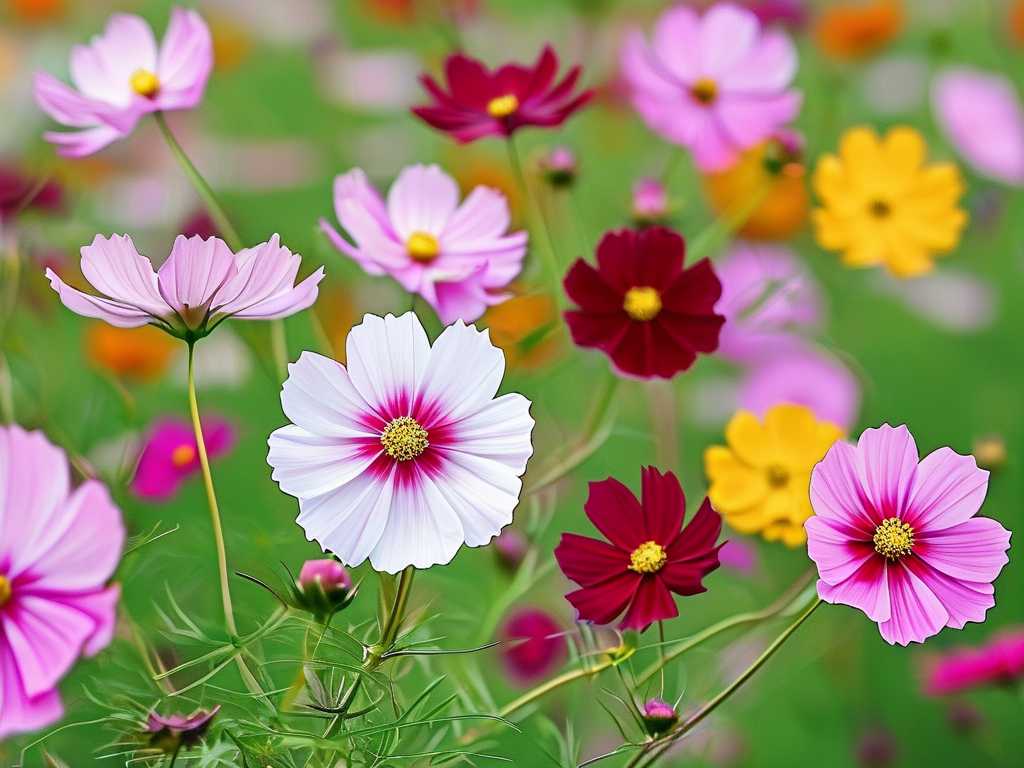
Cosmos bipinnatus: The flowers are typically larger, often 3-5 inches across. The petals (ray florets) are smooth-edged, broad, and arranged in a single, elegant layer around a central disc, though double-flowered cultivars exist. The classic color range is where this variety shines: pristine whites, soft pinks, vibrant magentas, and deep rose shades. The central disc is usually a contrasting yellow. These flowers embody a classic cottage garden aesthetic. According to the American Horticultural Society’s (AHA) encyclopedia, C. bipinnatus is celebrated for its “pastel to vivid pinks and whites,” which aligns perfectly with what I observed.
Cosmos sulphureus: The blooms are generally smaller, about 2-3 inches in diameter. The petals often have a slightly notched or ragged tip, which is a subtle but consistent clue. Their fiery color spectrum is the dead giveaway: brilliant oranges, sunny yellows, and deep, scarlet reds. You won’t find pink or pure white in true C. sulphureus. The plant screams “hot, vibrant summer.” Observing the color range is the single fastest way to differentiate between the two main species.
Trait Three: Plant Habit and Height
This is crucial for garden planning and another excellent identifier.
Cosmos bipinnatus: These plants are the taller, more ethereal ones. They readily reach 3 to 6 feet in height if left unstaked. Their growth is more vertical, and they can get leggy, especially in rich soil. I learned the hard way that planting them in overly fertile ground leads to lots of leaves and fewer flowers—a classic pitfall. The solution? They thrive in average to poor, well-drained soil. Their stature makes them perfect for the back of a border.
Cosmos sulphureus: This species is generally more compact and bushy, typically ranging from 1 to 3 feet tall. It forms a denser, shrubbier mound. This makes it ideal for the middle of a bed or container gardening. I found them to be more tolerant of a wider range of soil conditions without becoming overly leafy.
Introducing the Key Player: Cosmos ‘Sensation’ and Other Popular Cultivars
Now, let’s talk about specific types of cosmos you’ll likely encounter. After mastering the species basics, identifying popular cultivars becomes a fun puzzle. I focused on a few common ones.
One of the most famous is the Cosmos bipinnatus ‘Sensation’ mix. This was a cornerstone of my observation. These are the classic, tall, single-flowered cosmos. Over my two-week watch, I noted their rapid growth to about 4 feet, their incredibly fine, feathery foliage, and their large, open-faced blooms in pinks, whites, and crimsons. They are the quintessential “cut-and-come-again” flower, with long, slender stems perfect for vases. If you see a very tall cosmos with delicate leaves and pastel-to-bright saucer-sized flowers, you’re probably looking at a ‘Sensation’ type.
Another group includes the double-flowered cosmos varieties, like ‘Double Click’ or ‘Sea Shells’. ‘Sea Shells’ was particularly fascinating to observe. Its petals are rolled into a unique fluted, tubular shape, resembling little seashells. The foliage is classic bipinnatus—fine and feathery—but the flower form is unmistakable. I initially worried these unique forms might be less hardy, but they performed just as robustly as their single-petaled cousins.
For the Cosmos sulphureus side, look for cultivars like ‘Bright Lights’ or ‘Ladybird’. ‘Bright Lights’ offers a stunning mix of the classic orange, yellow, and red shades on compact, bushy plants. Observing these confirmed the species traits: coarser leaves, smaller blooms, and a vibrant, heat-loving disposition.
What About Chocolate Cosmos (Cosmos atrosanguineus)?
This is a special case and a delightful outlier. It’s a different species altogether. The giveaway? The deep, velvety maroon flowers that smell distinctly of dark chocolate—especially on warm afternoons. The foliage is also different; it’s more like a delicate, multi-fingered hand rather than the feathery or coarse divided leaves of the others. It often grows from tuberous roots, unlike the annual seed-grown habits of the common cosmos.
Bringing It All Together: Your Quick-Reference Checklist
So, when you’re faced with an unknown cosmos, walk through this list:
- Look at the leaves: Feathery and fine (C. bipinnatus) or broader and coarser (C. sulphureus)?
- Check the flower color: Pinks, whites, magentas (C. bipinnatus) or oranges, yellows, reds (C. sulphureus)?
- Note the plant’s shape: Tall and airy (C. bipinnatus) or compact and bushy (C. sulphureus)?
- Examine the bloom: Large, smooth petals, or smaller, sometimes notched petals?
This systematic approach never failed me after my initial trial-and-error period.
Questions I Often Get Asked
Can cosmos varieties cross-pollinate if planted together? Yes, they can, especially within the same species. If you save seeds from a pink C. bipinnatus planted next to a white one, the next generation might produce flowers in a mix of colors or something in between. To maintain a pure variety for seed saving, plant different cultivars far apart or choose only one type.
Why are my cosmos plants so tall with very few flowers? You’ve hit the same snag I did! This is almost always due to soil that is too rich in nitrogen. Cosmos, particularly C. bipinnatus, flourish in soil that isn’t overly fertile. Rich soil promotes lush foliage at the expense of blooms. The remedy is simple: don’t fertilize them. In fact, they perform best in tough love conditions with full sun and moderate water.
Is there an easy cosmos for beginners that’s easy to identify? Absolutely. Start with the Cosmos sulphureus ‘Bright Lights’ mix. Its compact, bushy form, distinct coarser leaves, and exclusively warm-colored flowers make it very easy to recognize. It’s also incredibly easy to grow from seed and blooms prolifically, giving you quick gratification and a clear example of one of the two main species.
Learning to distinguish between cosmos varieties has deeply enriched my gardening experience. It’s moved me from a passive admirer to an engaged observer. It allows for intentional garden design, successful seed saving, and a greater appreciation for the diversity within a single flower genus. The process taught me that careful, repeated observation is the most powerful tool a gardener has. Start with the leaves, note the colors, consider the plant’s posture, and you’ll unlock the simple secrets to telling these beautiful annuals apart. Your garden, and your bouquets, will be all the better for it.