bluename
 How to Distinguish Hyacinth and Grape Hyacinth Varieties: A Gardener’s Practical Guide
For years, I found myself squinting at bulb catalogs and nursery labels, utterly confused. Is that a hyacinth or a grape hyacinth? They sound similar, look somewhat alike in photos, and both herald spring. But planting the wrong one can lead to unexpected results in your garden design and care routine. I decided to end the confusion once and for all. I purchased several bulbs of each, documented a hands-on comparison over two weeks of active growth, and learned to spot the differences from bulb to bloom. If you’ve ever mixed them up or wondered which one you actually have, this guide is for you.
Understanding the Fundamental Differences: It Starts in Your Hand
Before they even touch soil, these plants reveal their identities. My journey began at the gardening center, where I picked up bags labeled Hyacinthus orientalis (common hyacinth) and Muscari armeniacum (common grape hyacinth).
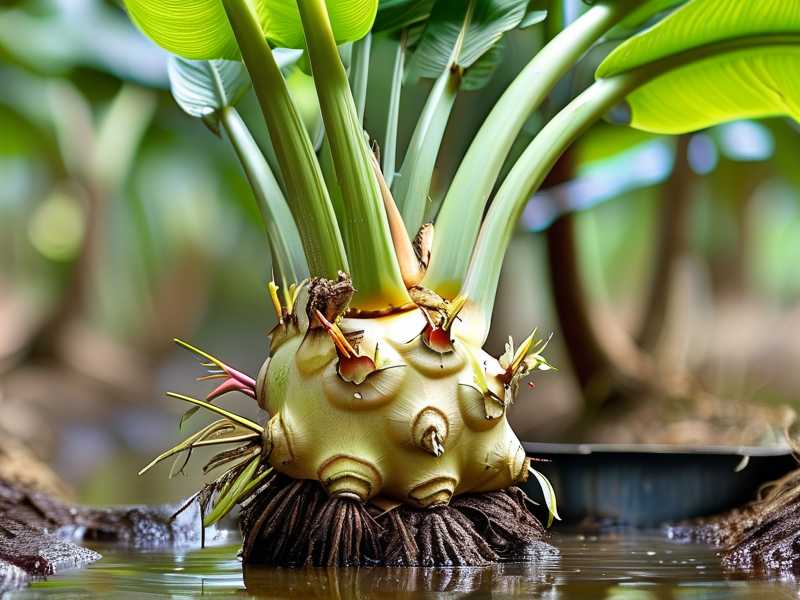
The hyacinth bulb felt substantial in my palm, like a firm, plump onion. It was larger, typically 4-5 inches in circumference, with a papery tunic that was often purplish or tan. It had a distinct, slightly pointed top where the shoot would emerge. In contrast, the grape hyacinth bulb was small, rarely over 2 inches around. It felt more like a miniature, solid tulip bulb, often with a darker, net-like tunic. Holding them side-by-side, the size difference was unmistakable—one was a heavyweight, the other a lightweight.
The Sprouting Test: First Leaves Tell a Tale
I planted them in well-draining pots on the same day, placing them in a cool, bright spot. Here’s where my two-week observation period became crucial. I checked progress every other day.
Within the first week, the hyacinth made its move. A single, thick, and fleshy green shoot pushed forcefully through the soil. It looked like a sturdy, closed cone. As it grew to about 3 inches, the individual, strap-like leaves began to unfurl from this central spear. They were broad, glossy, and deep green, forming a neat, upright cluster.
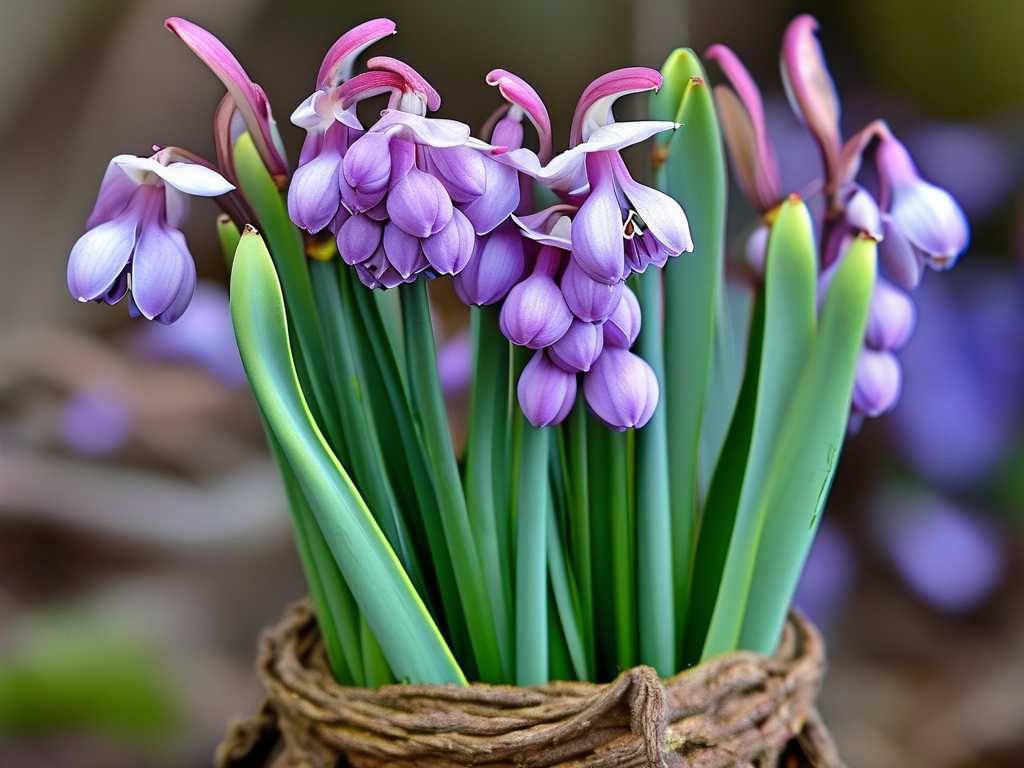
The grape hyacinths, however, played a different game. Multiple, much thinner and grass-like leaves emerged from each small bulb. They were narrow, linear, and often had a slight groove. They didn’t form a tight spear but rather a loose, floppy tuft that sprawled slightly. Within ten days, it was clear: one type produced a single, bold shoot; the other sent up a handful of slender, grassy leaves. According to the Royal Horticultural Society (RHS), this growth habit is a key diagnostic feature. Muscari species are noted for their semi-erect, basal foliage that appears in autumn or spring, distinct from the solitary, upright leaf cluster of Hyacinthus.
The Flower Show: Where Confusion Blooms and Clarity Emerges
This is the moment most people get puzzled. Both bloom in spring with dense flower clusters. But their structures are worlds apart.
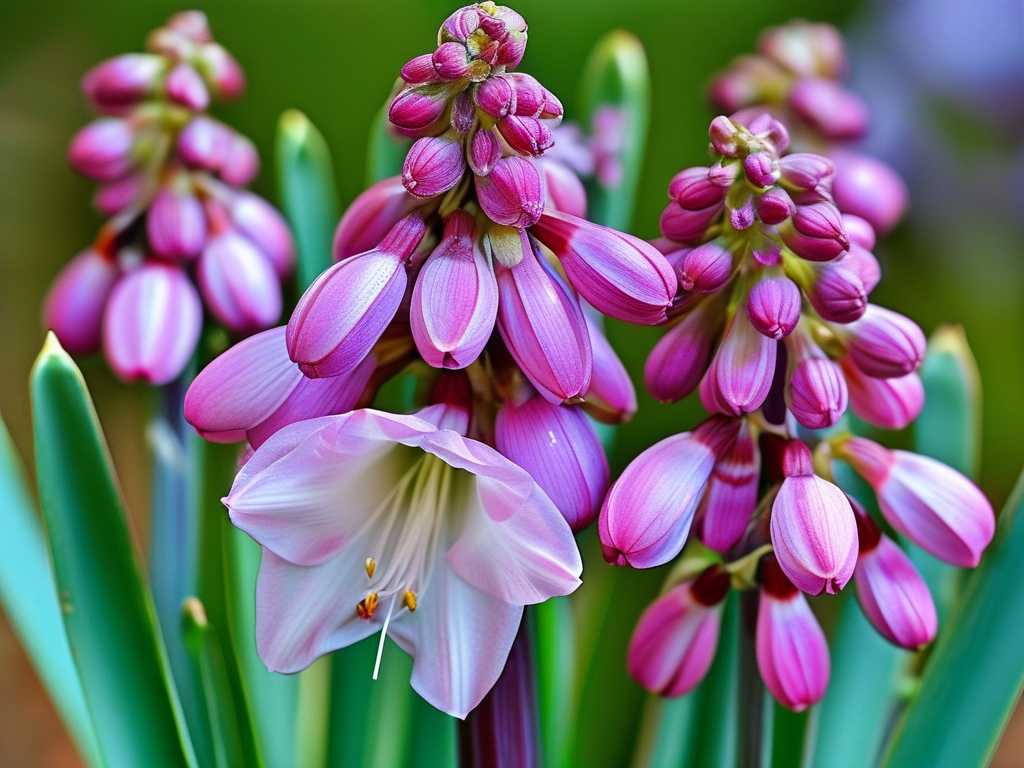
After about 14 days of growth, the flower buds developed. My hyacinth’s central spike thickened into a magnificent, dense raceme packed with dozens of starry, waxy florets. Each floret had a tiny, reflexed lobe, but together they created a solid, cylindrical “lollipop” of color—vibrant pink in my case. The fragrance was intense and sweet, filling the entire room. The American Horticultural Society’s A-Z Encyclopedia of Garden Plants describes hyacinth inflorescences as “dense, cylindrical racemes,” which is perfectly accurate. The stem was stout, almost succulent, holding the heavy bloom proudly upright.
My grape hyacinths produced a much smaller, oval to cylindrical raceme atop a slender, leafless stem. The flowers were tiny, rounded, and tightly packed, truly resembling an upside-down bunch of grapes or little porcelain bells. Their color was a uniform cobalt blue with subtle white rims. The scent was very faint, almost grassy. Crucially, I noticed the florets near the top were often a paler, sterile blue, while the fertile, darker blue ones hung below—a classic Muscari trait.
A Pitfall I Encountered and How I Solved It
My biggest mistake came from assuming all “blue spikes” were the same. I once planted what I thought were ‘Blue Jacket’ hyacinths for a strong blue statement. They emerged with those grassy leaves, and I initially thought they were just underperforming. When they bloomed as petite blue grape clusters, I realized my error—I’d bought Muscari ‘Armeniacum’ by mistake. They were lovely, but not the bold, fragrant centerpiece I’d planned.
The solution was meticulous labeling. Now, I never rely on memory. I use waterproof tags at planting, noting not just the name but key features: “Large bulb, single shoot” for hyacinths, and “Small bulb, grassy clump” for grape hyacinths. I also photograph the bulbs and their packaging next to the planted pots. This simple habit saves endless springtime confusion.
Beyond the Basics: Distinguishing Popular Varieties
Once you’ve mastered the species-level difference, you can appreciate the variety within each group. Let’s focus on two or three core types.
For common hyacinths (Hyacinthus orientalis), look for the flower density and form. The ‘Delft Blue’ hyacinth has a classic, densely packed spike in a soft porcelain blue. The ‘Woodstock’ hyacinth offers a stunning deep plum-magenta spike with an incredible fragrance. A semantic variant, the single hyacinth variety, distinguishes these from the less common multi-stemmed or “multiflora” types, which have several looser spikes per bulb.
Among grape hyacinths (Muscari), the shape of the flower cluster is key. The Armenian grape hyacinth variety (Muscari armeniacum) is the standard, with fat, top-heavy clusters of navy blue flowers. The plume grape hyacinth variety (Muscari comosum ‘Plumosum’) is wildly different—its flower spike is a feathery, sterile violet puff, bearing no resemblance to grapes. Another useful term is compact grape hyacinth type, which describes cultivars like ‘Valerie Finnis’ with pale blue, tightly formed spikes.
Why Getting It Right Matters for Your Garden
Choosing correctly impacts your garden’s timing, scent, and structure. Hyacinths are show-stopping solo performers best for borders, pots, or forcing indoors. Their large bulbs need planting deeper (about 6 inches) and benefit from replacing every few years as they decline. Grape hyacinths are naturalizers. They thrive in rockeries, lawn edges, or under deciduous trees, multiplying freely to form a blue carpet. They’re shallow planters (about 3 inches deep) and are largely care-free. The RHS recommends them for reliable, long-term spring ground cover. Planting a grape hyacinth where you wanted the dramatic height and scent of a hyacinth leads to disappointment, and vice-versa.
What is the main visual difference when they are in bloom? The flower structure is the clearest giveaway. Hyacinths produce a single, thick, and densely packed cylindrical spike of fragrant, waxy flowers. Grape hyacinths produce smaller, oval clusters of tiny, rounded, bell-shaped flowers on a slender stem, with little to no fragrance.
Can they be planted together? Absolutely, and they can be quite complementary. Plant hyacinth bulbs deeper in the center or back of a grouping, with grape hyacinth bulbs scattered more shallowly around their base. The hyacinth provides height and fragrance, while the grape hyacinth creates a colorful underplanting. Just be mindful that grape hyacinths will spread over time.
One comes back every year stronger, the other seems to fade. Is this normal? Yes, this is typical behavior. Grape hyacinths (Muscari) are vigorous naturalizers; they multiply readily and return more thickly each year. Common hyacinths often put on a spectacular show in their first year but may produce smaller, looser flower spikes in subsequent seasons. Many gardeners treat them as annuals or lift and fertilize the bulbs after flowering to encourage better performance.
Whether you’re planning a fragrant spring border or a naturalized woodland patch, knowing your hyacinth from your grape hyacinth is essential. From the heft of the bulb to the form of the flower spike, each step of their growth offers clues. My two-week side-by-side observation turned guesswork into certainty. Remember to label diligently, appreciate their unique roles in the garden, and you’ll never be fooled by their similar names again. The right bulb in the right spot guarantees a spring display that meets, and exceeds, your expectations.