bluename
 How to Control the Proper Spacing When Repotting Sunflowers Well
I love the bold, cheerful faces of sunflowers turning towards the sun. But for years, my own attempts to grow them in pots often ended in disappointment—spindly stems, crowded leaves, and blooms that were just… underwhelming. The turning point came when I realized I was ignoring one of the most critical, yet frequently overlooked, aspects of container gardening: proper spacing when repotting sunflowers. It’s not just about giving them a bigger pot; it’s about strategically planning their real estate from the start. Getting this spacing right is the secret sauce between a sunflower that merely survives and one that thrives with vigorous growth and massive, seed-filled heads.
Through trial, error, and a dedicated two-week observation period after repotting, I’ve dialed in a process that works. Let me walk you through the exact steps, the mistakes I made along the way, and how correct spacing fundamentally transforms your potted sunflowers.
Why Spacing is Your Sunflower’s Make-or-Break Factor
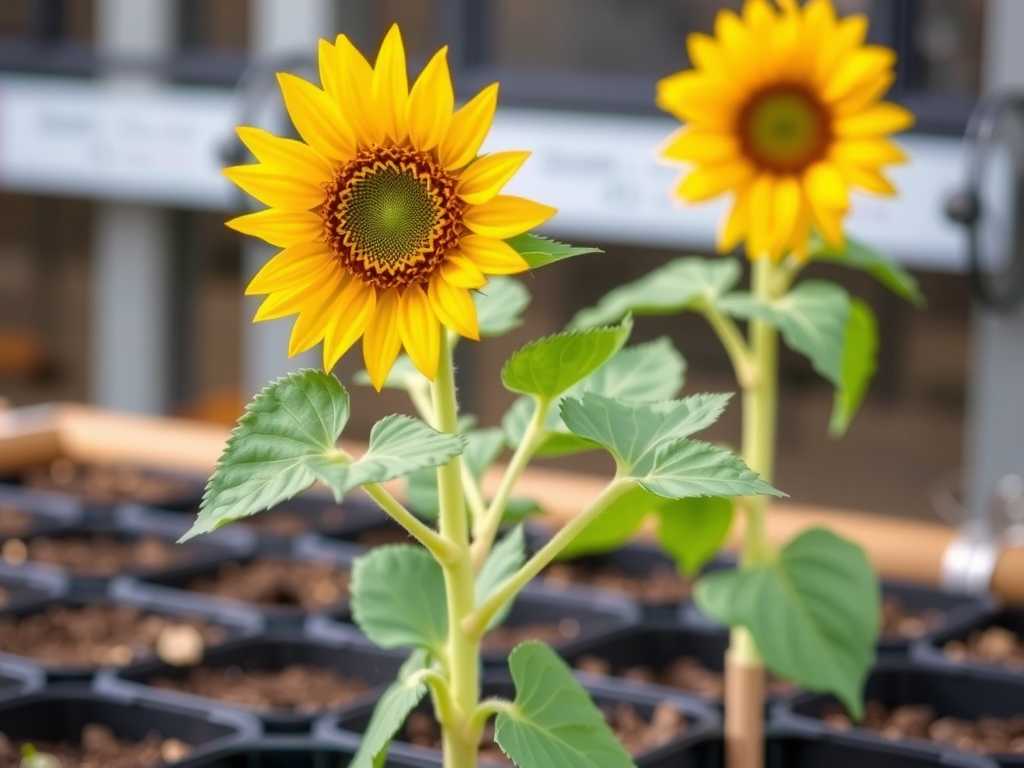
Think of a sunflower’s roots and leaves as its personal infrastructure. Crowd them, and the entire system collapses. Insufficient spacing when transplanting seedlings leads to a brutal competition for resources. The roots become tangled, fighting for every drop of water and nutrient in the limited soil volume. Above the soil, the leaves overlap, creating a humid, stagnant environment that’s a paradise for fungal diseases like powdery mildew.
The Royal Horticultural Society (RHS) emphasizes that for healthy development, plants require adequate room for root run and air circulation around their foliage. This isn’t just a suggestion; it’s a physiological necessity. Proper spacing directly influences stem strength, leaf size, and ultimately, the flower’s ability to produce a large, heavy head without toppling over.
My Step-by-Step Guide to Mastering Sunflower Spacing
Here is the exact methodology I now use, which has consistently yielded my best results.
Choosing the Right Pot: The Foundation of Good Spacing
The pot is your first spacing decision. My old mistake was using a pot that was “big enough” but not “optimal.” For a single, large variety like ‘Mammoth’ or ‘Russian Giant,’ you need a container that is both deep and wide. I now use a pot that is at least 16-18 inches in diameter and depth for one plant. This provides roughly 2-3 gallons of soil volume, giving the extensive taproot room to descend and the lateral roots space to spread.
For those interested in growing multiple sunflowers in one container—a technique often called companion planting in containers—the calculus changes. Dwarf or branching varieties like ‘Sunspot’ or ‘Teddy Bear’ can be grouped. In a 20-inch diameter pot, I successfully grow three plants by placing them in a triangle formation, ensuring each has its own 8-10 inch diameter circle of space. The American Horticultural Society (AHA) notes that for most medium-sized annuals, a general rule is to space plants so their mature foliage just touches, promoting a full look without overcrowding. I apply a slightly wider rule for sunflowers due to their large leaves.
The Repotting Process: A Gentle Transition
- Preparation: I water the seedlings thoroughly in their original cells a few hours before the move. This reduces transplant shock. I fill my new, clean pot with a high-quality, well-draining potting mix, leaving a hole in the center deep enough for the root ball.
- The Critical Move: Gently squeeze the seedling cell and tip the plant out, supporting the base of the stem. I never pull it. The key here is to minimize root disturbance during sunflower transplant. I carefully loosen any visibly coiled roots at the bottom with my fingers, but I leave the main soil ball intact.
- Precision Placement: I set the seedling into the hole. For a single plant, it goes dead center. For multiple plants, I use a measuring tape to position them equidistantly from the edges and each other. This is the moment proper spacing when repotting sunflowers is locked in. I adjust the soil level so the seedling is planted at the same depth it was growing before—burying the stem can invite rot.
- Backfill and Settle: I fill in around the root ball with soil, gently firming it to eliminate large air pockets. Then, I give it a gentle, deep watering to help the soil settle around the roots.
The First 48 Hours and Two-Week Observation
Right after repotting, I place the pots in a spot with bright, indirect light for 48 hours. This allows them to recover from the move without the added stress of intense sun. I resist the urge to fertilize; fresh potting mix has nutrients, and fertilizer can burn stressed roots.
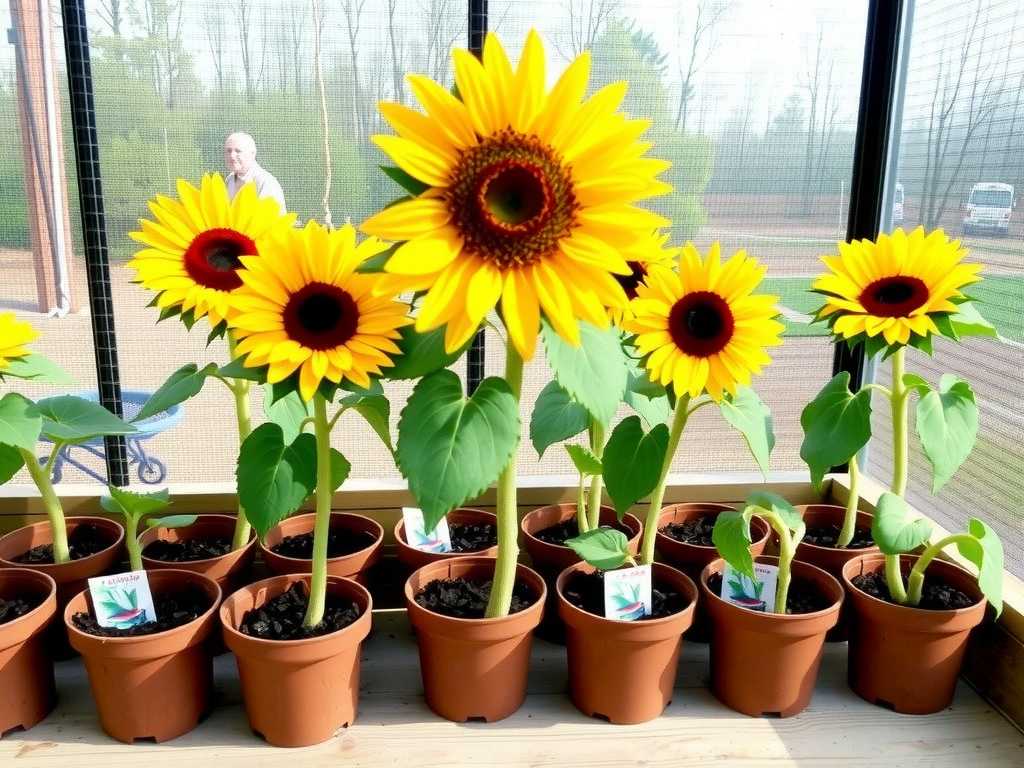
Here’s what I observed over the next two weeks with correct spacing:
- Days 1-3: A slight wilt or pause in growth is normal. My well-spaced sunflowers perked up by the end of day two.
- Days 4-7: Visible new growth! The stems began to thicken, and new leaf pairs emerged. There was no yellowing of the lower leaves—a sign they weren’t being shaded out by neighbors.
- Days 8-14: The difference became stark. The plants grew steadily upward and outwards, with leaves expanding fully without overlapping. The soil moisture was even and dried at a consistent rate, indicating roots were spreading healthily throughout the pot. In a past, crowded pot, I’d see wild variations in moisture and early lower leaf drop.
The Pitfalls I Encountered and How to Fix Them
My biggest mistake was underestimating mature size. I once planted two ‘Mammoth’ seedlings in a 14-inch pot, thinking I could manage them. By week three, they were a tangled mess. The solution was painful but necessary: I removed the weaker seedling entirely. It was a lesson in the hard economics of space. It’s better to have one spectacular plant than two stunted ones.
Another error was improper watering after repotting. I used to water lightly and frequently. An expert gardener pointed out that this encourages roots to stay shallow. Instead, I now water deeply and less frequently, which, combined with ample root space, encourages the deep, stabilizing root growth sunflowers are famous for.
Optimizing Growth After Spacing is Set
With spacing handled, your sunflowers need support. When they reach about 12 inches tall, I insert a sturdy bamboo stake a few inches away from the stem and use soft plant ties in a figure-eight pattern to secure it. This prevents wind rock from damaging those carefully spaced roots.
As for feeding, I begin a bi-weekly dose of a balanced, water-soluble fertilizer once the plants are clearly established (around week 3 after repotting). Too much nitrogen early on can lead to lush leaves at the expense of flowers, so I follow the AHA’s guidance on feeding for bloom production.
Addressing Your Top Questions
Can I repot a sunflower that has become too tall and leggy in its first pot? Yes, but be extra cautious. The taller the plant, the more transplant shock it can experience. Bury the stem deeper in the new pot (up to the first set of true leaves) to provide stability and encourage new roots to form along the buried stem. Provide immediate staking and shade for 3-4 days.
How do I know if my potted sunflowers are too crowded? Watch for tell-tale signs: stems that are thin and stretch desperately toward light, lower leaves consistently turning yellow and dying, soil that dries out impossibly fast, or a general slowdown in growth. If the leaves are constantly overlapping and the center of the plant feels damp and airless, it’s time to thin or repot.
What is the absolute minimum pot size for one sunflower? While you can keep a dwarf variety in a 10-12 inch pot, for standard large sunflowers, a 14-inch diameter pot is the absolute minimum I would recommend for a single plant. Anything smaller severely restricts the root system, limits nutrient uptake, and increases the risk of the plant becoming top-heavy and blowing over.
Mastering the art of spacing is what separates a hopeful gardener from a successful one. It’s a proactive decision that pays dividends every single day of your sunflower’s life. By giving those roots and leaves the room they were designed to have, you’re not just planting a flower; you’re engineering an environment for a masterpiece. The result is a stronger, healthier, and more spectacular bloom that truly lives up to the glorious potential of the sunflower.