bluename
 How to Distinguish Phalaenopsis Varieties and Dendrobium Varieties: A Complete Guide for Orchid Enthusiasts
Have you ever found yourself admiring a stunning orchid display, only to wonder, “Is that a Phalaenopsis or a Dendrobium?” You’re not alone. For many plant lovers and budding horticulturists, telling these two popular orchid genera apart can be surprisingly tricky. They both boast beautiful, long-lasting flowers and are staples in homes and gardens worldwide. Yet, confusing a Phalaenopsis variety with a Dendrobium variety can lead to improper care, disappointing blooms, and a frustrated gardener. This guide is designed to demystify these botanical beauties. We’ll equip you with a clear, step-by-step system to confidently identify whether you’re looking at a Phalaenopsis or a Dendrobium, and even delve into recognizing popular types within each group. By the end, you’ll navigate the orchid aisle with the eye of an expert.
Understanding the fundamental differences between Phalaenopsis and Dendrobium orchids is the first and most crucial step. While they share the orchid family name, their growth patterns, physical structures, and care needs are distinct. Mastering these basics will transform your ability to identify and care for them.

The most reliable starting point is examining the plant’s growth habit, or how it physically grows. Phalaenopsis orchids are monopodial. Imagine a single, central stem that grows vertically. New leaves emerge from the top of this stem in an alternating pattern, while the roots often sprout along the stem, sometimes creeping out of the pot. The plant doesn’t have traditional horizontal “runners.” In contrast, Dendrobium orchids are typically sympodial. They grow horizontally via a rhizome, producing individual upright stems called “pseudobulbs.” Each pseudobulb is a self-contained storage unit for water and nutrients. You’ll see a cluster of these cane-like stems, with leaves growing along their length.
Next, take a close look at the leaves. Phalaenopsis leaves are broad, flat, fleshy, and oval-shaped. They are arranged in a loose rosette pattern from the single stem, usually numbering between 3 to 6 mature leaves. Their texture is smooth and often a deep, glossy green. Dendrobium leaves are generally narrower, more elongated, and leathery. They grow in two rows along the length of the pseudobulb. In many deciduous Dendrobium varieties, these leaves may turn yellow and drop during a dry rest period, which is a behavior you’d never see in a standard Phalaenopsis.
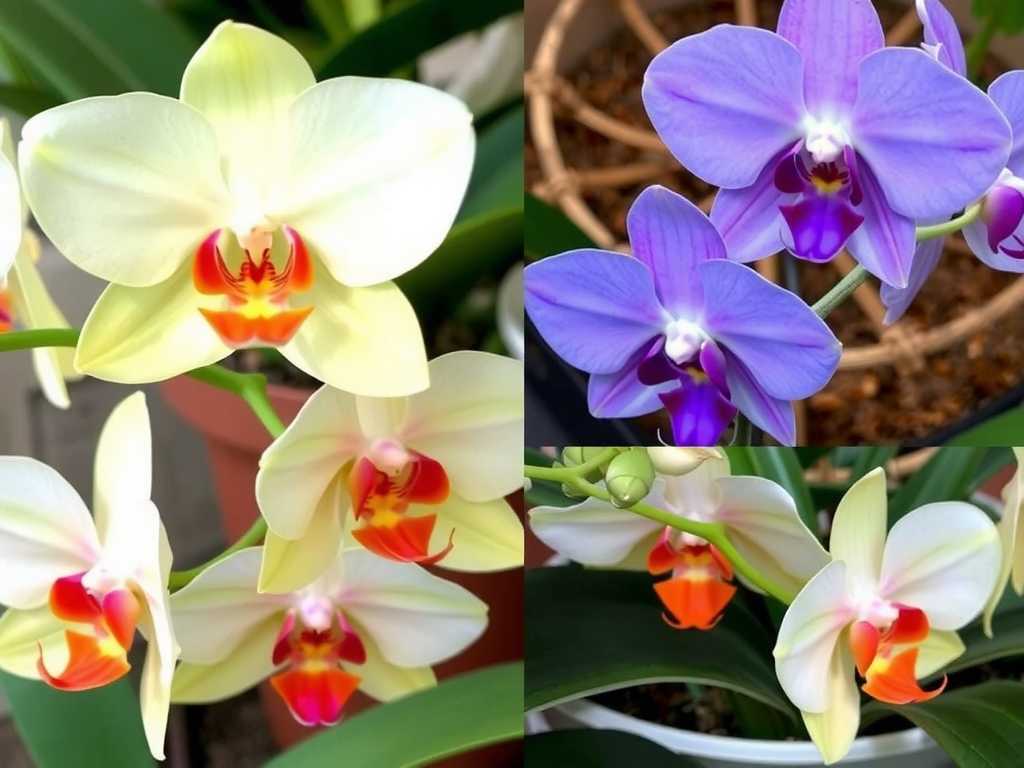
The flowers, while all beautiful, offer clear clues. Phalaenopsis blooms are often described as “moth-like” due to their broad, rounded petals and sepals. The lip is usually prominent and complex, and flowers are commonly arranged on a long, arching spray that emerges from the stem between the leaves. Dendrobium flower shapes are more diverse but often feature narrower petals. A classic Den. nobile type, for instance, has flowers that cluster closely around the cane. Their inflorescence can be a short spray from the top of the pseudobulb or small clusters along the cane’s length.
Finally, consider the root system. Phalaenopsis roots are thick, silvery-green, and covered in a spongy layer called velamen. They are adapted to absorb moisture from the air and often happily grow outside the potting medium into the air. Dendrobium roots are typically finer, more fibrous, and whiter in color. They are more likely to be confined within the pot, though some species can be aerial.
Now that you can separate the two genera, let’s explore the diversity within each. Recognizing common Phalaenopsis varieties and Dendrobium varieties adds another layer to your orchid knowledge.
Standard Phalaenopsis (Complex Hybrids): These are the ubiquitous “moth orchids” found in grocery stores and garden centers. They feature large, rounded flowers on tall, arching spikes. Colors range from pure white and soft pink to deep purple and spotted patterns. They are known for their exceptionally long bloom period, often lasting months.
Multiflora or “Twinkle” Phalaenopsis: These varieties produce numerous smaller flowers on branching spikes, creating a abundant, cascading effect. The individual flowers are smaller but profuse, offering a different aesthetic than the standard large-flowered types.
Peloric Phalaenopsis: These unique varieties have mutations that cause the petals to mimic the shape of the lip, resulting in a striking, symmetrical, and sometimes star-shaped bloom. They are highly sought after by collectors for their unusual form.
Dendrobium nobile Hybrids: Perhaps the most recognizable Dendrobium type. They feature tall, cane-like pseudobulbs that drop leaves in winter. In spring, fragrant flowers burst directly from the nodes (notches) along the leafless cane. They require a distinct cool, dry winter rest to rebloom.
Dendrobium phalaenopsis Hybrids (Den. bigibbum): Named for their flower’s resemblance to Phalaenopsis, these have long, upright sprays of flowers that last for weeks. Their pseudobulbs are often slender, and they do not require a severe dry rest, making them somewhat easier for beginners.
Hard-Cane vs. Soft-Cane Dendrobiums: This is a key distinction. Hard-cane types (like Den. phalaenopsis) have evergreen, tall, sturdy pseudobulbs. Soft-cane types (like Den. nobile) have softer, fleshy canes that may be deciduous. Their care, especially regarding winter watering and temperature, differs significantly.
To build authority, it’s helpful to reference established horticultural frameworks. The Royal Horticultural Society (RHS), the international orchid registrar, classifies orchids into distinct alliances and grexes, a system that professional breeders rely on. As noted by orchid botanist Dr. Mark Chase, “While hybrids blur some morphological lines, the fundamental architecture of the pseudobulb in Dendrobiums versus the monopodial stem in Phalaenopsis remains the most foolproof identifier for growers.” This underscores that the growth habit we discussed is the cornerstone of accurate identification.
Armed with this knowledge, you can apply a simple, practical identification checklist in any setting, from a nursery to a friend’s home.
First, look at the base of the plant. Do you see a single, short stem with broad leaves fanning out (Phalaenopsis), or multiple tall, cane-like stems clustered together (Dendrobium)? This is your quickest visual cue.
Second, inspect the flower spike. Is it a long, arching or upright spray emerging from the leaf axil (Phalaenopsis), or are the flowers clustered along or at the top of a tall cane (Dendrobium)?
Third, consider the foliage texture and pattern. Are the leaves broad, flat, and arranged in a low rosette (Phalaenopsis), or are they narrower, growing in two rows along a tall stem (Dendrobium)?
Finally, ask about seasonal behavior. Does the plant stay green year-round with sporadic blooms (typical Phalaenopsis), or does it have a cycle where it loses leaves and requires a dry rest to flower (common for many Dendrobiums)?
Can a Phalaenopsis and Dendrobium be crossbred? While both are orchids, they belong to different genera and subtribes. Crossbreeding them directly is biologically impossible. Hybridization occurs within the same genus or between very closely related genera. So, you will not find a true “Phalaenodendron” hybrid.
Which is easier for a beginner, Phalaenopsis or Dendrobium? For most beginners, the standard Phalaenopsis is the unequivocal recommendation. Its care is consistent year-round: moderate, indirect light, consistent moisture, and no mandatory dry rest period. Many Dendrobium varieties, particularly the popular Nobile type, have specific seasonal requirements that can be challenging for newcomers.
Why is my Dendrobium not flowering, while my Phalaenopsis blooms reliably? This is almost always tied to cultural needs. Most flowering Dendrobiums require a stimulus to initiate bloom spikes, which is often a combination of cooler nighttime temperatures and a significant reduction in watering for several weeks in the fall or winter. Your Phalaenopsis, on the other hand, may rebloom with just a slight temperature drop and consistent care. The key is knowing which Dendrobium variety you have to provide its specific dormant period.
Distinguishing between these two magnificent orchid groups unlocks a deeper appreciation for their unique beauty and needs. By focusing on the foundational differences in growth habit—the monopodial form of the Phalaenopsis versus the sympodial pseudobulbs of the Dendrobium—you build an unshakable foundation. From there, observing leaf structure, flower arrangement, and seasonal patterns allows you to refine your identification skills further. Remember, successful orchid cultivation begins with knowing what you have. With this guide, you’re now prepared to not only tell them apart but also to provide the tailored care that will reward you with spectacular, healthy blooms for seasons to come.