bluename
 How to Identify Different Cornflower Varieties? A Gardener's Practical Guide
Have you ever found yourself admiring a stunning patch of blue in a garden, only to wonder, "Is that a cornflower?" You're not alone. For years, I struggled to tell the classic cornflower from its many beautiful cousins. I'd buy seeds labeled simply "cornflower" and end up with a surprise mix of colors and forms. My garden lacked cohesion, and my attempts at creating specific color schemes often fell flat. The core problem was my inability to accurately identify different cornflower varieties. This guide is the result of my journey from confused enthusiast to confident identifier, packed with the hands-on steps, observations, and hard-earned lessons from my own garden.
My mission began with a simple goal: to clearly identify and grow three distinct types in my own backyard. I dedicated a full season, with an intensive 2-week observation period during peak growth, to learn their true signatures. Here’s exactly how I learned to spot the differences, and how you can, too.
Start with the Basics: Understanding the Cornflower Family
First, let's clarify the name. When we say "cornflower," we're typically talking about Centaurea cyanus. Also known as bachelor's button, it's an annual plant beloved for its vivid blue, fringed petals. However, the Centaurea genus is vast, containing perennials and other species often confused with the classic annual. Proper identification starts with knowing which branch of the family you're examining.
According to the Royal Horticultural Society (RHS), accurate identification is crucial not just for aesthetics, but for understanding plant needs. They note that Centaurea species can have varying requirements for sunlight, soil, and pruning. Mistaking a drought-tolerant perennial for a moisture-loving annual can lead to poor plant health.
My Hands-On Identification Framework: A 3-Step Process
I developed a three-step framework focusing on plant habit, flower structure, and foliage. I applied this to three popular varieties: the classic annual cornflower (Centaurea cyanus), the perennial mountain bluet (Centaurea montana), and the striking sweet sultan (Centaurea moschata). I grew them side-by-side in well-labeled but initially hidden plots to test my skills.
Step 1: Analyze the Plant's Growth Habit and Height
This is your first major clue. I observed my plants daily for two weeks as they moved from young growth to pre-bloom stage.
- Classic Annual Cornflower (Centaurea cyanus): This variety grows in a distinctly upright, branching form. My plants reached between 60 to 90 cm (24 to 36 inches) tall. The stems are slender and wiry. As the American Horticultural Society (AHA) emphasizes, this annual habit means the plant completes its life cycle in one season, focusing energy on prolific flowering.
- Perennial Mountain Bluet (Centaurea montana): The growth was completely different. It formed a spreading clump, growing outwards as much as upwards. Its height capped at around 45-60 cm (18-24 inches). The stems were sturdier and leafier from the base. Observing this clump-forming habit over 14 days made it unmistakable against the upright annuals.
- Sweet Sultan (Centaurea moschata): This one presented a more compact, bushy habit. It was the shortest of the three, staying around 30-45 cm (12-18 inches). The stems were thick and carried the flower heads aloft with almost no branching lower down.
The Pitfall I Encountered: I initially over-watered the Centaurea montana, treating it like the annuals. The perennial's dense clump retained too much moisture at its crown, leading to slight mildew. The fix was simple but vital: I adjusted my watering to target the soil, not the plant, and increased spacing for air flow. This taught me that identification directly impacts care.
Step 2: Decode the Flower Head and Florets
This is where the magic happens. The structure of the flower head is the most reliable identifier. I spent hours with a magnifying glass.
- Classic Annual Cornflower: The flower head is what we all imagine. It features a central disc of tiny, tubular florets surrounded by a ring of large, spreading, deeply fringed "ray florets." The blue is iconic, but cultivated varieties ('Black Ball,' 'Polka Dot Mix') offer deep purples, pinks, and whites. The fringe is dramatic and unmistakable.
- Perennial Mountain Bluet: The flower head is similar but often larger. The critical difference is in the ray florets. They are less dramatically fringed—more deeply lobed or cut, but not into fine threads. The center is darker, sometimes almost black, creating a striking contrast with the usually violet-blue petals. It blooms earlier in my season than the annual.
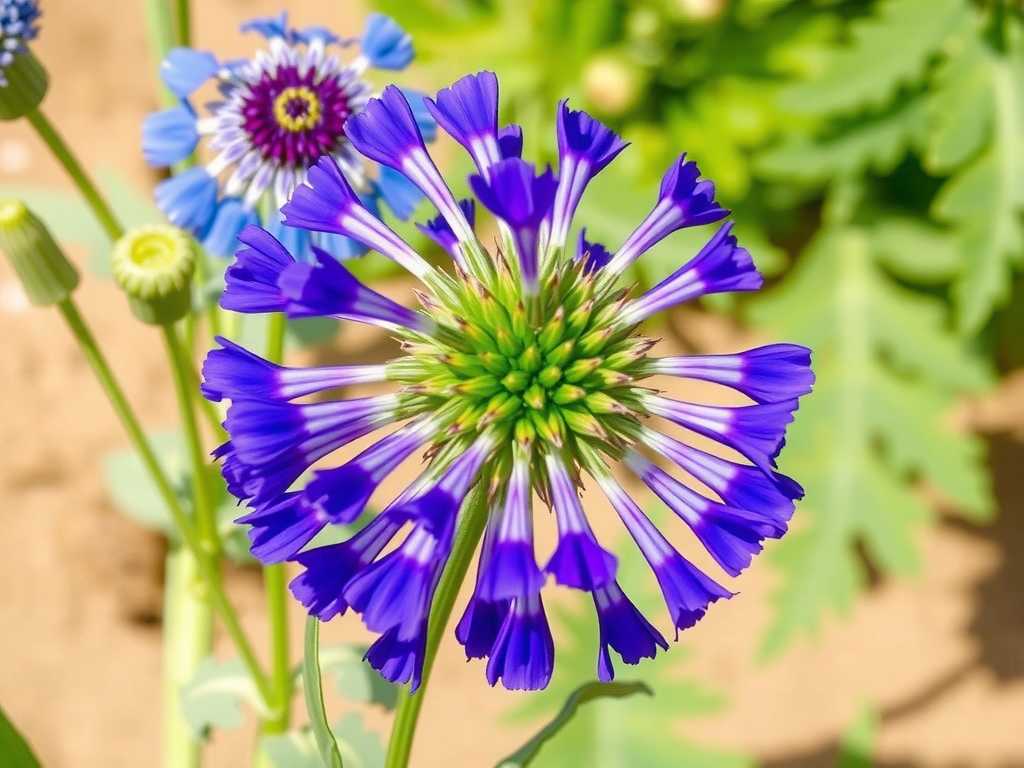
- Sweet Sultan: This flower head is a globe of delight. It looks like a fluffy pom-pom. Why? The ray florets are highly dissected into countless fine threads, creating that soft, fuzzy appearance. The scent is also a giveaway—it has a light, sweet, spicy fragrance, unlike the almost scentless classic cornflower. Colors range from white and yellow to purple.
The Pitfall I Encountered: I confused a double-flowered cultivar of Centaurea cyanus with a Sweet Sultan from a distance. Both looked "fluffy." Up close, the difference was clear: the double cornflower's fringes were still organized in a distinct ring, while the Sweet Sultan's threads formed a uniform sphere. The lesson? Always inspect up close; don't rely on color or shape from afar.
Step 3: Inspect the Leaves and Stems
Foliage provides consistent clues, even when the plant isn't in bloom.
- Classic Annual Cornflower: The leaves are long, lance-shaped, and a grayish-green color. They are alternate on the stem and can look almost thread-like on younger plants. The stem is angular and slightly hairy.
- Perennial Mountain Bluet: The leaves are broader, oblong to lance-shaped, and a brighter green. They are mostly basal (growing from the bottom clump), with smaller leaves on the stems. This was a key identifier during my 2-week observation when flowers weren't present.
- Sweet Sultan: The leaves are pinnately lobed—meaning they have a feather-like appearance with deep cuts along a central rib. They are a soft, gray-green and feel slightly fuzzy to the touch. This distinct leaf shape made it the easiest to identify in the vegetative stage.
Key Differences Between Annual and Perennial Cornflowers
This is a common point of confusion. Beyond the life cycle, the RHS notes that perennials like Centaurea montana often have more extensive, sometimes invasive, root systems (rhizomes) and benefit from division every few years. Annual Cyanus relies on seed propagation. The perennial's foliage often persists, while the annual's dies completely.
Leveraging Expert Resources for Confirmation
When in doubt, I cross-reference. I use the RHS's online plant selector and the AHA's gardening guides. I also took clear photos of my plants' habit, flower head cross-sections, and leaves, and compared them to botanical databases. This practice solidified my confidence and turned guesswork into a systematic process.
Bringing It All Together in Your Garden
Now, I plan my garden with intention. I use the tall, airy annual cornflowers for mid-border height and cutting. The perennial mountain bluet forms a reliable, spreading clump at the front of my border, returning stronger each year. The fragrant, compact sweet sultan is perfect for containers and edging. Knowing their identities allows me to meet their specific needs for a thriving display.
Frequently Asked Questions
I have a cornflower that came back this year. Does that mean it's a perennial? Not necessarily. Classic annual cornflowers (Centaurea cyanus) are prolific self-seeders. It's very likely the parent plant died, but it dropped seeds that germinated the following spring. A true perennial like Centaurea montana will return from the same root crown, growing larger and expanding its clump each year.
What is the most common blue wildflower mistaken for a cornflower? Chicory (Cichorium intybus) is often mistaken from a distance. It has similar bright blue flowers, but they are square-tipped and grow on a tall, rigid, branching stem with very different, dandelion-like basal leaves. Up close, the flower structure is not similar at all.
Can I identify the variety just by the seed packet? Reputable seed companies will list the full botanical name (Centaurea cyanus vs. Centaurea montana). Always check for this. Descriptions like "tall," "cutting variety," or "perennial" are strong hints, but the Latin name is the only surefire way to know exactly what you're planting before it grows.
Learning to identify different cornflower varieties has transformed my gardening. It moved me from passive observer to active curator of my space. It prevented care mistakes, saved money on mislabeled plants, and allowed me to create the precise garden aesthetic I envisioned. The process requires a bit of focused observation—those two weeks of daily checking were invaluable—but the reward is a deeper connection to your garden and the undeniable satisfaction of knowing exactly what you're growing. Grab your magnifying glass and start looking; the clues are all there, waiting to be discovered.